Most people who search for conductor school in Texas end up hired straight off the street by a railroad. The two biggest employers, Union Pacific and BNSF, both state in their postings that no previous railroad experience is required and that the company trains you. This guide walks through what the postings actually ask for, how training works, what it pays and what the first years look like.
Key facts
- Union Pacific Train Crew training runs 14 weeks of classroom and on-the-job training (UP Train Crew FAQs).
- BNSF Conductor Trainee training is up to 19 weeks, company paid, with travel to its training center in Overland Park, Kansas (BNSF Houston posting, Nov 4, 2026).
- The same BNSF posting lists an entry rate of about $259.65 per day and an average annual salary of $70,000 to $82,000.
- Texas had 4,640 railroad conductors and yardmasters in May 2025, with a median wage of $68,980 (BLS OEWS).
What a conductor does
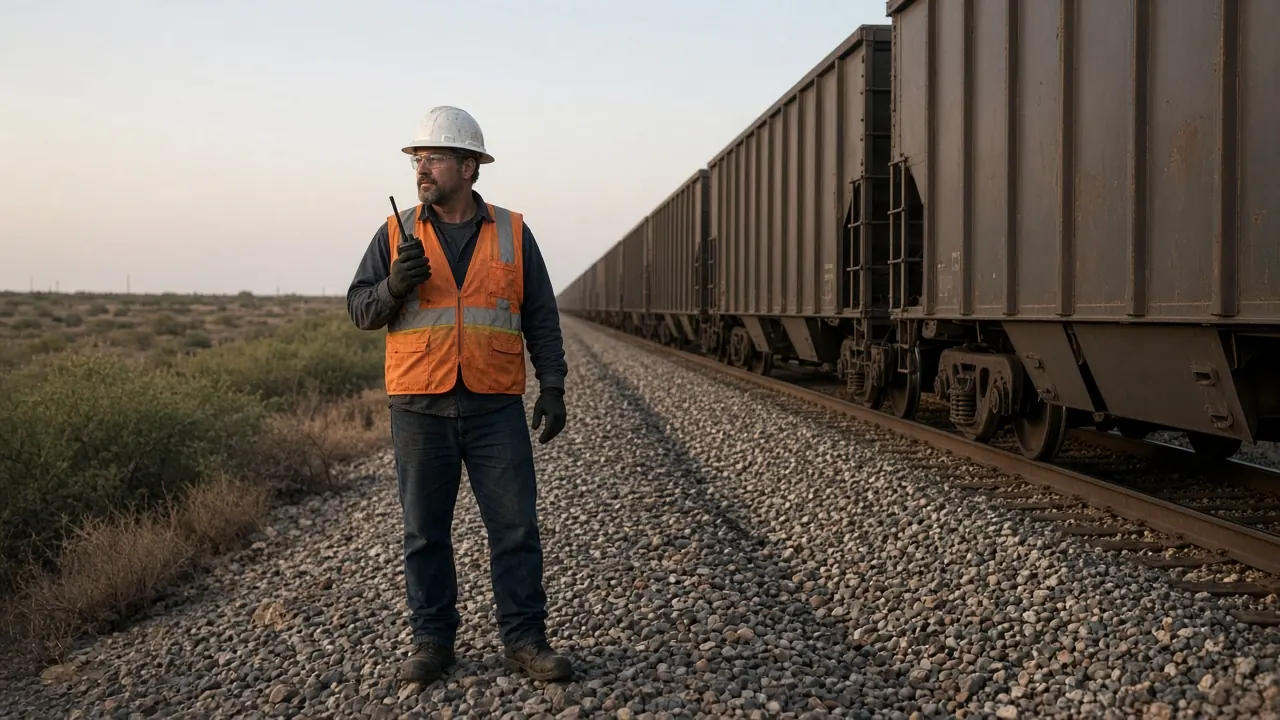
A freight conductor is in charge of the train and its paperwork. The BNSF posting lists the work plainly: climbing on and off equipment, setting hand brakes, connecting air hoses, replacing broken knuckles, lining switches and derails, inspecting cars under federal rules, and reading signals and hand signals to judge speed and clearance. Union Pacific describes yard and local crews that sort cars from inbound trains and build outbound trains, and road crews that run between two terminals and may stay overnight away from home, with lodging provided.
On passenger and commuter lines the job adds customers. The CapMetro Rail Conductor posting in Austin includes fare inspection, announcements and helping passengers during delays, on top of switching and flagging.
The posted requirements
These are the requirements as the Texas postings state them. They are short, and none of them is a school certificate.
| Requirement | Union Pacific Train Crew | BNSF Conductor Trainee |
|---|---|---|
| Minimum age | 18 | 18, or by the start date |
| Experience | No railroad experience required | Not listed as required |
| Physical | Physical Ability Test, lift and carry up to 85 pounds | Lift and carry up to 80 pounds |
| Vision | Normal color vision and depth perception | Distinguish red, blue, green, yellow and lunar, and see at night |
| Testing | Random, reasonable-suspicion and post-accident drug and alcohol tests | Background check, medical review and pre-employment drug screen |
| Commitment | Plan to stay in your craft and location at least 2 years | Some locations carry a 3-year recall obligation |
Union Pacific also requires passing an English assessment before the interview. BNSF uses a hair drug test at its hiring events that looks back about 90 days, and it says you cannot move forward without an adequate hair sample (BNSF pre-employment process).
How training works
Union Pacific publishes its 14-week schedule: two weeks of new-hire classroom, two weeks of on-the-job training, two weeks of conductor classroom, two weeks of conductor on-the-job training, two weeks of remote control operator classroom and four weeks of remote control on-the-job training. The exams require at least 85 percent, and the switch assessment requires 100 percent. Missing more than three days can lead to termination, according to the same FAQ.
BNSF's Houston posting says training lasts up to 19 weeks and includes travel to Overland Park, Kansas. That is the home of the National Academy of Railroad Sciences at Johnson County Community College, which BNSF partners with.
Federal rules sit underneath all of this. Conductors on U.S. railroads must be certified under 49 CFR Part 242, and the railroad that employs you runs the testing. The BLS notes that certification includes a written test, a skills test and knowledge of the physical route.
Do you need conductor school first?
No Texas college offers a railroad conductor certificate in the federal CareerOneStop training finder as of November 10, 2026. The best-known program is the Railroad Conductor certificate at Johnson County Community College in Overland Park, Kansas, offered as a 16-week fast-track hybrid or a two-semester online plan, each with one week on campus. It can help with short lines or passenger operators that want experience. For Union Pacific and BNSF it is optional, because both train new hires themselves. See our training programs directory for details.
What it pays
Pay comes in two very different numbers, and both are real.
- Posted pay. BNSF lists about $259.65 per day at entry and $70,000 to $82,000 as an average annual salary for Houston conductor trainees (posting dated Nov 4, 2026).
- Survey pay. BLS OEWS puts the Texas median for conductors and yardmasters at $68,980 and the 90th percentile at $79,400 for May 2025.
BLS OEWS wages are straight-time pay. They leave out overtime pay, shift differentials and nonproduction bonuses, and they come from an employer survey, so they can sit well below the total earnings a railroad quotes in a posting. See railroad pay in Texas for every figure side by side, the conductor pay and hiring timeline for stage-by-stage pay, and the pay calculator.
Wages move with national bargaining. SMART-TD members on BNSF and several other railroads ratified a five-year agreement on October 30, 2025, with compounded wage increases of 18.77 percent, the first 4.0 percent retroactive to July 1, 2025 (SMART Union).
The schedule is the real test
Every Texas conductor posting says the same thing in different words. BNSF says the job is subject to on-call 24/7, nights, weekends and holidays, with frequent travel inside your seniority region. Union Pacific says you may work an assignment that is on call 24 hours a day, 7 days a week, that you will likely not get paid time off in your first year aside from sick days, and that furloughs are possible when business drops.
Federal law caps a train employee at 12 consecutive hours on duty, followed by at least 10 consecutive hours off (49 U.S.C. 21103). Within those limits, seniority decides who gets the better jobs, and new hires usually start on the extra board, covering vacancies as they come up.
A realistic path, step by step
- Pick your hiring location carefully. You hold seniority where you hire, and both railroads say transfers are not guaranteed. Apply only where you are willing to live.
- Apply to a specific posting. BNSF postings close about seven days after they open. Union Pacific asks you to complete an English assessment before the interview.
- Prepare for the screens. Expect a background check, a medical review with vision and hearing, a drug test and a physical ability test. Read our hiring process and tests guide.
- Finish training. Plan for 14 to 19 weeks with exams and attendance rules.
- Ride the extra board. Keep your phone on, your bag packed and your driving record clean.
- Move up. BLS says most locomotive engineers first work as conductors for several years. See locomotive engineer jobs.
Who should not apply
If you need a fixed schedule, cannot pass a hair test, or cannot commit to one location for two or three years, a freight conductor job will be a hard fit. Commuter and light rail jobs in Dallas, Fort Worth, Austin and Houston offer more regular shifts at lower pay. See commuter and light rail jobs in Texas.
Common questions
How long does it take to become a train conductor in Texas?
Union Pacific trains new Train Crew hires for 14 weeks. BNSF lists up to 19 weeks for Conductor Trainees. Hiring screens before training can add several weeks.
Do I need a degree or certificate to be a conductor?
No. The Texas postings from Union Pacific and BNSF ask for age 18 or older, the ability to pass screens and physical requirements, and no prior railroad experience. Neither lists a school certificate as required.
How much do conductors make in Texas?
BNSF's Houston posting (Nov 4, 2026) lists about $259.65 per day at entry and an average annual salary of $70,000 to $82,000. BLS OEWS lists a Texas median of $68,980 for conductors and yardmasters in May 2025.
Can I choose my schedule?
Not at first. Both railroads say new conductors can be on call around the clock, and seniority decides who gets regular assignments.
Next steps
Looking for railroad work in Texas?
Tell us about your background and we will reach out if a fit comes up. This is not an application to a railroad.
Sources
- Union Pacific, Train Crew FAQs (read Nov 10, 2026)
- Union Pacific, Train Crew - Kansas City, MO/KS posting (up.jobs, read Nov 11, 2026)
- BNSF, Conductor Trainee - Houston, TX posting (dated Nov 4, 2026)
- BNSF, Pre-Employment Qualification Process (read Nov 10, 2026)
- eCFR, 49 CFR Part 242, Qualification and Certification of Conductors
- BLS Occupational Outlook Handbook, Railroad Workers (last modified Sep 14, 2026)
- BLS Occupational Employment and Wage Statistics, Texas, May 2025 (series OEUS48...; read via api.bls.gov Nov 10, 2026)
- BLS OEWS Technical Notes (wage definition)
- Johnson County Community College, Conductor Certificate Options (read Nov 10, 2026)
- CareerOneStop, Local Training Finder: Railroad Conductors and Yardmasters (read Nov 10, 2026)
- SMART Union, SMART-TD members ratify new five-year agreement with 18.77% wage increases (Oct 30, 2025)
- 49 U.S.C. 21103, Limitations on duty hours of train employees
- CapMetro, Rail Conductor posting (listed Sep 15, 2026, via PublicTransitJobs.org)
Figures are quoted as the source states them, on the date shown. Job postings change or close; confirm details on the employer page before you apply.